
Some products are dreamed up in a boardroom. This one was lived.
The story behind Intellicore's collaboration with Pilotis, and why the construction and design industry deserves better software.

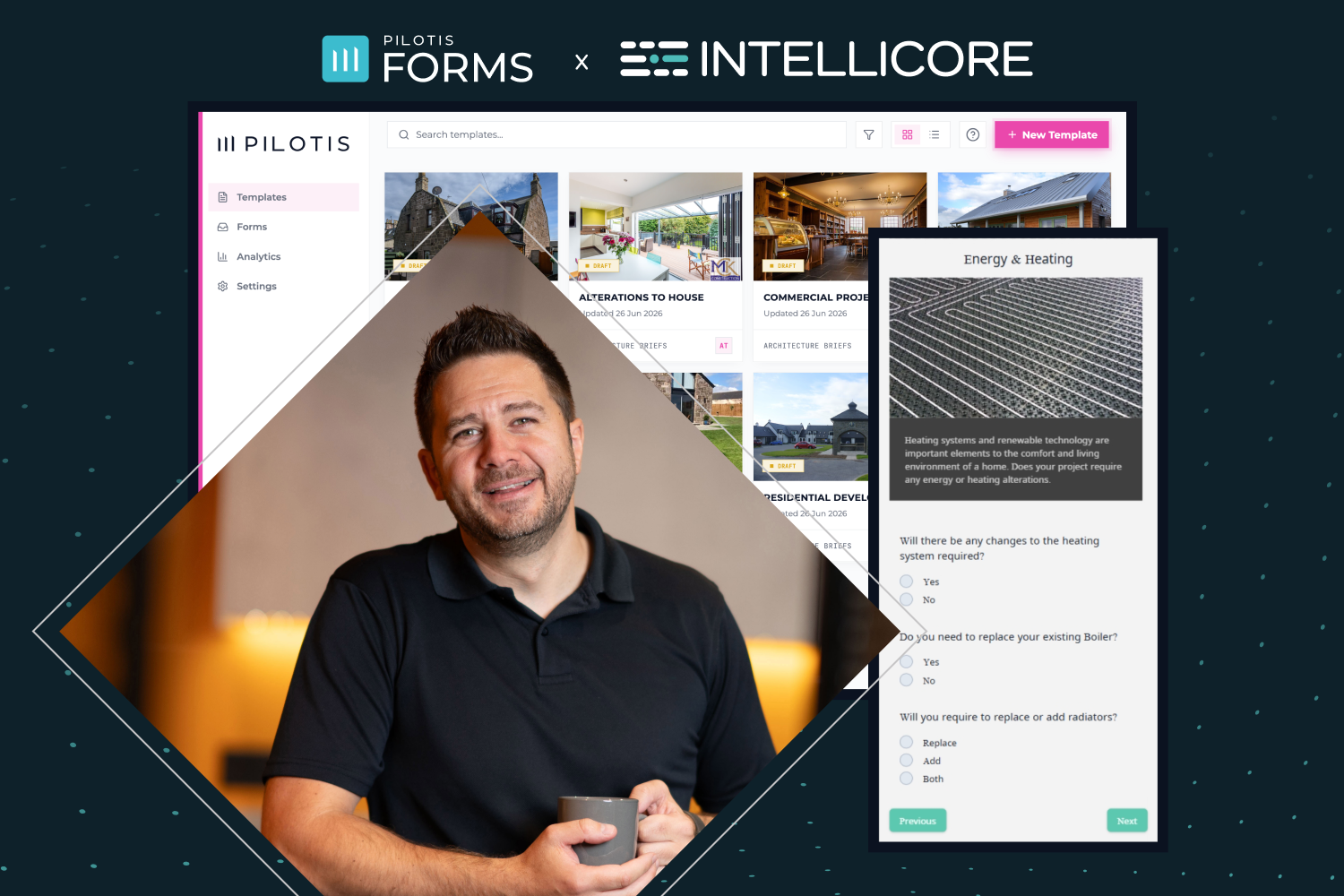
I grew up surrounded by home renovation and property development. It was simply how my family worked: buying, building, improving, moving on to the next. By the time I reached early adulthood it was so normalised that my first home wasn't a starter flat - it was a full-scale property development project.
Those years put me in the same room as a lot of architects and a lot of trades. And they gave me something a spec sheet never could: a first-hand view of how these projects actually feel from the inside, for the professionals delivering them and for the people living through them.
The problem I couldn't unsee
What became obvious, project after project, was the sheer complexity of it all. Not the engineering or the design - those are the parts people train their whole careers for. The complexity lived in the spaces between: the roles, the hand-offs, the communication.
Architects, engineers, contractors, specialists, suppliers and clients all move through a project on slightly different timelines, with slightly different information, each making decisions that ripple outward. When those decisions aren't visible to the right people at the right moment, small misalignments compound quietly until they surface as expensive, stressful surprises.
The result is something I saw again and again: the most exciting project of a person's life - the one they saved for, dreamed about, and finally committed to - feeling like nothing but a burden by the time it reaches completion. The joy gets ground down by friction that nobody intended and everybody suffered.
It was clear to me, even then, that there was a better way of working. Not a better architect or a better builder - a better process, supported by the right tools, that could:
- Keep everyone aligned around a single, shared source of truth
- Ensure the right professionals are involved in the decisions that need them
- Surface issues early, so surprises are designed out rather than discovered late
- Keep the client genuinely engaged, informed, and - crucially - still happy at the end
When the professions stay aligned, the client stays confident. When the client stays confident, the whole project runs better. That virtuous circle became the thing I wanted to build.
From engineer's vision to industry reality
I'm a software engineer. I could see the shape of the solution, and I understood - viscerally - the problem it needed to solve. But understanding a problem as a former client is not the same as understanding it as the architect who runs a practice every single day.
The idea became real through a conversation with Kevin Crawford.
Kevin has spent more than 20 years running Crawford Architecture, the family practice his father founded in 1987. He knows the discipline from the inside: the workflows, the pressures, the commercial realities, and the day-to-day frustrations that never make it into a textbook. He was exactly the person to keep my engineer's vision honest - grounded in what the practices who'd become our customers actually need.
That partnership is the heart of Pilotis. My job was to make sure the software was genuinely capable. Kevin's was to make sure it was genuinely useful - that every feature earned its place against the real needs of a working practice.
Kevin believed in it enough to commit fully - since Crawford Architecture transitioned to shared ownership last year, Pilotis has been his focus - and today we launch the first product in what will become a full suite: Pilotis Forms, structured brief capture built for architects.
Why start with the brief?
Because under the RIBA Plan of Work, Stage 1 is literally called "Preparation and Brief" - and everything downstream traces back to it. Cost. Scope. Disputes. The brief is the most expensive document in the whole project, and most practices still capture it like it's 2005: a notepad, an email chain, a version of the truth that lives in three places and matches in none.
Pilotis Forms replaces that with structured capture across the moments that matter - initial enquiry, developed brief, specification choices, completion - with every decision recorded and every sign-off in one place.
Where Intellicore fits
Pilotis is its own organisation, with its own identity and its own path ahead. But it didn't build itself.
Intellicore is the development team behind Pilotis - and, for me personally, the vehicle through which the original vision was engineered into a real, working product. If Pilotis is the destination, Intellicore is a big part of how it got built. We're proud to have turned a lived problem into software the sector can actually use.
The return on investment
Software for this industry only matters if it pays its way. Here's where the value comes from:
Fewer costly surprises. The most expensive moments in any project are the ones nobody saw coming: a decision made without the right input, a change discovered too late to absorb cheaply. Keeping the right professionals in the loop on the right decisions shifts problems from "discovered late and expensive" to "caught early and cheap." Rework avoided is margin protected.
Less time lost to coordination. A significant portion of every professional's day is spent chasing status, reconciling versions, and re-explaining decisions. When everyone works from a shared, current picture, that overhead shrinks - freeing skilled, expensive people to do the work only they can do.
Faster, cleaner decisions. When the right information reaches the right person at the right moment, decisions get made once, correctly, instead of being revisited. Momentum is one of the most underrated assets in a project.
Happier clients - and the revenue that follows. An engaged, informed client refers, returns, and leaves the kind of reputation that wins the next commission. In a referral-driven profession, client experience isn't a soft benefit; it's a pipeline.
Protected professional reputation. A smooth project is a marketing asset; a stressful one is a liability. Consistency of delivery compounds into brand value over time.
A note on numbers: we're deliberately describing where the value comes from rather than quoting figures. As our early-access data matures, we'll publish measured results - so customers can see the return, not just infer it.
What better looks like for the sector
The ambition is bigger than any single practice. Construction and design is one of the most economically and culturally important things we do as a society - and yet it's often coordinated with tools that were never designed for how these projects genuinely work.
If alignment becomes the norm rather than the exception - if surprises are engineered out, clients stay engaged, and skilled professionals spend less time firefighting and more time creating - the whole sector lifts. Projects finish better. People stay in love with the work. And the most exciting project of someone's life gets to feel that way all the way to the finish line.
That's the standard we're building toward.
What's next
Pilotis Forms is the first of a suite, already proven with early-access practices. More is coming - we expect the next product to move from beta into full release in the second half of 2026.
This is the beginning, not the destination. If you're an architect, a practice, or a professional in the building industry who's felt the friction I've described, we'd love for you to see what we've built.
See Pilotis Forms at pilotis.com.
Pilotis is developed by Intellicore.
%20(1).jpg)
.webp)
Subscribe to the Intellicore Newsletter
Sign-up and get frequent technology insights on topics including intellectual property and software development, security tools and integrating with API, delivered to your inbox.